

Blog Summary: Locum tenens physicians often receive 1099 income and must manage estimated taxes, self-employment tax, and eligible business deductions. Key considerations include travel, housing, CME, licensing, malpractice, and equipment expenses, along with multi-state tax rules and business structures such as LLCs or S corporations.
Physicians who take on locum tenens assignments can have more control over their schedules and income. This type of work can also create new tax responsibilities. Many doctors receive 1099 income instead of a regular paycheck with tax withholding.
That means you need a clear plan for taxes, records, deductions, and payments. This guide explains the key parts of locum tenens taxes in simple terms. It also covers 1099 status, estimated taxes, business structures, and common deductions.
How Locum Tenens Income Is Taxed
Your tax treatment starts with your worker classification. Many locum physicians work as independent contractors and receive Form 1099-NEC. However, some positions may use W-2 employment.
The difference matters. W-2 employees usually have federal and state taxes withheld from their pay. Employers also handle their share of Social Security and Medicare taxes. Independent contractors handle these payments themselves.
The IRS considers an independent contractor self-employed. Self-employed workers generally report business income and expenses on their tax returns. According to the IRS Publication 505 – Tax Withholding and Estimated Tax, self-employed individuals may need to pay estimated taxes during the year.
So, are locum tenens independent contractors? Often, yes. Still, you should confirm the classification stated in each contract. Do not assume every temporary medical position uses the same tax structure.
1099 And W-2 Work Compared
A 1099 arrangement gives you more responsibility for your tax planning. You may receive your full contracted payment without normal employee withholding. You then need to plan for income tax and self-employment tax. Understanding locum compensation can also help you plan for the taxes that come with contractor income.
W-2 employment works differently. Your employer generally withholds taxes from your wages. You may also receive employee benefits that are not part of a contractor arrangement.
Your work status can also affect how you handle expenses. Some business expenses may be deductible for a self-employed physician. However, employees generally cannot treat ordinary unreimbursed job costs in the same way.
The IRS states that business expenses must meet the ordinary and necessary standard. Personal expenses do not qualify simply because they relate to your lifestyle or work.
Planning For Estimated Tax Payments
A common surprise for new contractors is the lack of regular tax withholding. Your income may arrive without federal tax already taken out. You must plan for that liability yourself.
Estimated payments can cover both income tax and self-employment tax. The IRS generally requires estimated payments from individuals who expect to owe at least $1,000 when they file, although specific rules and exceptions apply.
For 2026, the general federal estimated tax dates are April 15, June 15, September 15, and January 15, 2027. Your situation may require a different calculation if your income changes during the year.
Do not treat these dates as a simple four-part savings plan. Your income may change between assignments. Your deductible expenses may also change. A tax professional can help you adjust payments during the year.
A separate savings account can also help. Move part of each contractor payment into that account. This creates a clear reserve for upcoming tax bills.
Common Tax Deductions for Locum Tenens Physicians
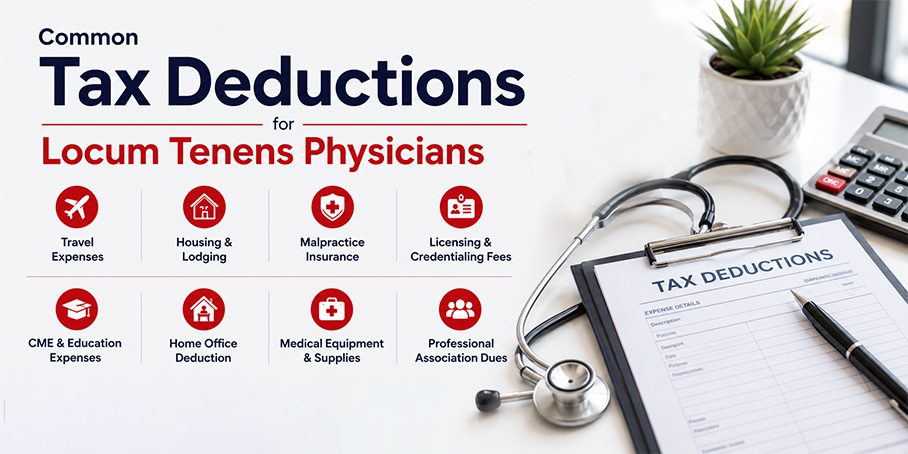
Many physicians ask about 1099 physician tax deductions because contractor income can come with legitimate business costs. However, a cost is not deductible simply because you paid it while working.
The IRS says a deductible business expense must be ordinary and necessary. You also need records that support the expense.
Here are common categories to discuss with your tax professional.
Business Travel
Travel can be a major cost for physicians who work away from home. Depending on your facts, qualifying business travel may include transportation costs, lodging, and other eligible expenses.
Keep records for each trip. Note the assignment location, dates, purpose, and costs. Also keep receipts and other supporting documents.
According to the IRS Standard Mileage Rates, physicians using their own vehicles for qualifying business travel can claim the applicable mileage deduction. The rate is 72.5 cents per mile from January 1 through June 30 and 76 cents per mile from July 1 through December 31, 2026.
Temporary Housing
Housing can become a major expense during a temporary clinical placement. A physician may have eligible lodging costs when the travel meets the applicable tax rules.
However, do not assume every hotel, apartment, or rental is deductible. Your tax home and the nature of the work location can affect the result.
Keep your lease, hotel invoices, payment records, and assignment details. These records can help your CPA determine the correct treatment.
Meals During Business Travel
Qualifying business travel may also include deductible meal costs. The rules have limits, so you should not treat every meal as a business expense.
The IRS notes that deductible business meal expenses can include meals while traveling away from home for business. In many cases, only a percentage of the cost is deductible.
Keep the receipt and note the business purpose. Also separate personal meals from qualifying business costs.
CME And Professional Education
Physicians often spend money on continuing medical education. Depending on the facts, costs tied directly to maintaining or improving professional skills may qualify as business expenses.
Examples may include eligible courses, conferences, and related educational costs. Keep registration records and receipts with your tax documents.
Licensing And Credentialing Fees
State licenses and professional registrations can create recurring costs for locum physicians. Certain work-related licensing and credentialing expenses may qualify as business costs when they meet IRS requirements.
Track each payment by state and assignment. This can also help when you work across several locations during the same year.
Malpractice Insurance
Malpractice coverage can be another important business expense. First, check who pays for the policy. A staffing agency or healthcare facility may cover the cost under the contract.
If you pay an eligible premium yourself, discuss the expense with your tax professional. Do not deduct an amount that another party already paid on your behalf.
Home Office Costs
Some physicians manage scheduling, records, billing, or other business tasks from home. However, that does not automatically make the home office deductible.
The IRS has specific requirements for business use of a home. Exclusive use is an important part of the rules.
Therefore, keep detailed records before claiming this deduction. Your CPA can determine if your workspace meets the applicable requirements.
Equipment And Technology
A self-employed physician may use a laptop, monitor, phone, software, or other tools for business. Some of these costs may qualify as business expenses.
Still, personal and business use must be separated when an item serves both purposes. The IRS specifically notes that mixed-use costs need to be divided between business and personal use.
Should You Form An LLC?
An LLC for locum tenens work can offer a formal business structure. It may also provide legal and administrative benefits. However, creating an LLC does not automatically reduce your federal tax bill.
According to the IRS Single Member Limited Liability Companies guidance, a single-member LLC is generally treated as a disregarded entity for federal income tax purposes unless the owner elects different treatment.
That means an LLC does not automatically change your federal tax treatment. State rules can also differ.
Before forming an LLC, consider your income, state rules, liability needs, administrative costs, and long-term plans. A CPA can help you compare the options before you spend money on a structure that may not fit your situation.
When An S Corp May Make Sense
Some physicians also consider S corporation taxation. This option can create potential tax planning opportunities in the right situation. However, it also creates more compliance work.
An LLC may elect corporate treatment if it meets the applicable rules. An S corporation then has its own payroll and reporting requirements.
Do not choose an S corporation based on a simple income number. Your tax savings depend on several factors. Payroll, reasonable compensation, professional fees, state taxes, and administrative costs all matter.
A tax projection can help you compare the options before making an election.
Managing Taxes Across Multiple States
Locum physicians may work in more than one state during the same year. This can make tax planning more complex.
You may need to consider both your home state and states where you perform services. Filing requirements can vary by state. Some states may also provide credits for taxes paid to another state.
Keep a record of every assignment. Track the state, dates worked, income received, and related expenses. This gives your tax preparer better information for state filings.
Your contract history can also support your records. Keep copies of contracts, pay statements, and reimbursement details in one place.
Keep Your 1099 Accounting Organized
Good locum tenens 1099 accounting starts with simple records. You do not need a complicated system to stay organized.
Start with a separate business account when appropriate. Then track income and expenses throughout the year. Avoid waiting until tax season to sort through months of receipts.
The IRS recommends keeping records that support income, deductions, and other information reported on your return.
A basic system should track:
- Assignment Income
- Business Travel
- Lodging Costs
- Mileage Records
- CME Expenses
- Licensing Fees
- Professional Fees
- Equipment Purchases
- Tax Payments
Also keep copies of invoices, receipts, contracts, and payment records. Good records make tax preparation easier and help you explain expenses if questions arise.
Why A Locum-Focused CPA Helps
A general tax preparer may understand self-employment. However, locum work can involve issues that deserve more focused planning.
A locum tenens CPA firm can help you review contractor income, estimated payments, deductions, entity choices, and multi-state obligations. The right professional can also help you build a tax plan before the year ends.
This is especially useful when your income changes often. It can also help when you move between several clinical locations.
Think of a CPA as part of your financial planning process. Good advice can help you avoid missed deductions and reduce preventable tax problems.
Final Thoughts On Locum Tenens Taxes
Locum tenens work can offer strong earning potential and greater schedule flexibility. However, contractor income also requires careful tax planning.
Start by confirming your work classification. Then track income, organize receipts, plan estimated payments, and review eligible deductions. If you work across multiple states or consider an LLC or S corporation, seek professional guidance before making a decision.
Understanding locum tenens tax planning can help physicians manage their finances more effectively throughout the year. Imperial Locum supports physicians by connecting them with locum opportunities that align with their career goals and professional needs.
FAQs
Do I Need to Make Estimated Tax Payments as a Locum Tenens Provider?
Many locum tenens providers make quarterly estimated tax payments because 1099 income usually has no tax withholding. A tax professional can help you estimate what to pay and when.
What Expenses Can Locum Tenens Providers Deduct?
Eligible expenses may include work-related travel, licensing fees, credentialing costs, exam fees, home office equipment, and health insurance premiums. Deductibility depends on your situation.
Can I Work Locum Tenens While Having a Full-Time Job?
Yes. Physicians and APPs can take locum tenens assignments while working full time if their schedules and contracts allow it. Some choose part-time shifts during weekends or other time off.
How Much Can a Physician Save Through Tax Planning?
Tax savings vary based on income, family circumstances, and investments. Strategies such as S-Corp planning, retirement contributions, and real estate investments may help reduce taxable income.
What Retirement Plan Is Best for a Self-Employed Physician?
A Solo 401(k) can be a strong option for self-employed physicians because it allows both employee and employer contributions. Higher earners may also consider a Cash Balance Plan.
Can W-2 Physicians Deduct Business Expenses?
Generally, W-2 physicians cannot deduct unreimbursed employee expenses on federal returns. However, physicians with 1099 income may deduct eligible expenses related to that business activity.
Can Physicians Use Real Estate to Reduce Taxes?
Real estate can provide tax benefits for physicians, depending on their circumstances. Strategies involving rental properties and cost segregation may help reduce taxable income when properly structured.
How Can Hiring My Spouse Help Reduce Taxes?
A physician may be able to hire their spouse through a legitimate business arrangement. This can create additional opportunities for retirement contributions and may provide a business deduction.
What Is the Spousal REPS Strategy for Doctors?
Spousal REPS refers to using a spouse’s Real Estate Professional status to potentially make rental losses more useful for tax purposes. The spouse must meet specific IRS requirements, including the required hours.