
Rural America needs more doctors. Millions of people live far from the nearest clinic. Many small hospitals go months with an open position they can’t fill.
Locum tenens physicians help bridge these workforce gaps. They are not just a short-term solution. In many rural communities, clinics, emergency departments, and critical access hospitals remain open while permanent recruitment continues. This is also why partnering with a healthcare staffing agency has become an important strategy for rural healthcare facilities seeking qualified clinicians.
This guide highlights the rural locations with the greatest demand for locum tenens providers, the specialties most in need, and the key factors to consider before accepting a rural assignment.
What Is Rural Locum Tenens?
Locum tenens is a Latin term. It means to hold the place of. A locum is a doctor, nurse practitioner, physician assistant, or CRNA. They take short-term jobs to cover a gap in staff.
Rural locum work happens in small hospitals and clinics. It also happens in health centers far from big cities. Often, one small team cares for a whole town.
Why Rural Towns Need Locum Doctors
The rural physician shortage stems from several compounding challenges:
- Single-Provider Coverage & Leave: Many small clinics operate with only one or two clinicians. When someone takes medical, parental, or vacation leave, no internal coverage exists.
- Extended Hiring Cycles: It can take over a year to recruit a permanent rural physician. Locum providers maintain continuous patient access during long search processes.
- Clinician Burnout: Working long hours in isolation leads to burnout, often causing unexpected departures.
- Demographic Shifts & Expanding Services: Retirees moving to rural communities increase local medical demand. Additionally, facilities introducing new lines of care (like behavioral health) use locums while building permanent teams.
How Shortages Impact Patient Access
According to the Health Workforce Data, Tools, and Dashboards from the U.S. Health Resources and Services Administration (HRSA), nearly 72% of primary care Health Professional Shortage Areas (HPSAs) are in rural communities.
When positions sit vacant, patients face longer drive times, delayed preventive care, and higher reliance on local emergency departments. Locum tenens coverage helps preserve essential care delivery while communities pursue long-term recruitment solutions.
Key Indicators of High-Demand Communities
Healthcare staffing agencies and providers evaluate several designations to measure demand intensity:
- HPSA & MUA Status: High Health Professional Shortage Area and Medically Underserved Area scores indicate severe provider deficits and high poverty or barriers to care.
- Critical Access Hospitals (CAHs) & REHs: Small facilities (often 25 beds or fewer) or Rural Emergency Hospitals rely on locum physicians to ensure 24/7 emergency coverage.
- Rural Referral Centers: Regional rural hospitals serving multiple counties experience widespread care disruptions if a key specialty position remains open.
- Seasonal Fluctuations: Agricultural peak seasons, tourist hubs, and winter retirement communities experience sudden demand spikes requiring short-term staffing.
Rural vs. Urban Locum Assignments
Rural and city locum jobs can look very different. Here is a quick comparison.
| Factor | Rural Assignment | Urban Assignment |
| Patient load | Fewer patients, more types of cases | More patients, more focused cases |
| Hours | Longer shifts, more on-call time | More set shift hours |
| Procedures | Doctors do more hands-on work | Experts often do this work |
| Independence | High, few specialists nearby | Lower, help is close by |
| Tools | Basic labs and imaging | Full labs, scans, and specialists |
| Housing | Often paid for or given | Rarely included |
| Travel | Long drives to bigger hospitals | Short trips between sites |
| Team size | Small, close team | Larger staff and departments |
| Local ties | Well known in town | One of many providers |
| Skill growth | Broad, general skills | Great, focused skills |
Top High-Demand Rural States & Regional Hotspots
While rural workforce needs exist nationwide, demand is particularly dense across specific states and geographic regions.
Highest-Demand States
- New Mexico & Arizona: Extensive rural acreage and high demand near tribal health systems require adaptable primary care and emergency clinicians.
- Montana & Wyoming: Sparse populations and long travel distances make Critical Access Hospitals heavily dependent on locum hospitalists and surgeons.
- Mississippi & West Virginia: High chronic disease burdens paired with rural hospital closures drive high demand for internal medicine, OB/GYN, and mental health coverage.
- Texas: Expansive geography leaves numerous rural counties with limited full-time coverage, keeping family medicine and ER demand high.
- North & South Dakota: Rapidly shifting energy sector populations and rural tribal clinics create continuous coverage needs.
Key Regional Hotspots
- Appalachia & Mississippi Delta: Economically challenged regions facing high rates of chronic illness and limited specialty access.
- Great Plains & Mountain West: Frontier counties where extreme weather and distance make local coverage essential.
- Alaska & Remote Tribal Reservations: Extremely remote clinics relying heavily on rotating locum providers and travel medicine clinicians.
Which Medical Specialties Are Most Needed?
Some specialties see far more rural need than others.
| Specialty | Why It’s Needed |
| Family Medicine | Often the only care option in a small town |
| Emergency Medicine | Small ERs need round-the-clock coverage |
| Internal Medicine | Manages chronic illness in older rural patients |
| Hospitalist | Covers inpatient care at small hospitals |
| Psychiatry | Rural mental health care is hard to find |
| General Surgery | Handles cases that would need a long drive elsewhere |
| Anesthesiology | Keeps surgery and birth units running |
| OB/GYN | Many rural hospitals have lost birth units |
| Pediatrics | Rural kids often lack nearby specialists |
| Radiology | Reads scans remotely for hospitals with no on-site radiologist |
| Cardiology | Heart disease is common in older rural patients |
| Orthopedics | Farm and factory work raise injury rates |
| Nurse Practitioners | Fill primary care and specialty gaps |
| Physician Assistants | Cover primary care and ER shifts |
| CRNAs | Often the only anesthesia provider on site |
Benefits of Rural Locum Assignments
Higher pay gets the most attention. But it is not the only perk.
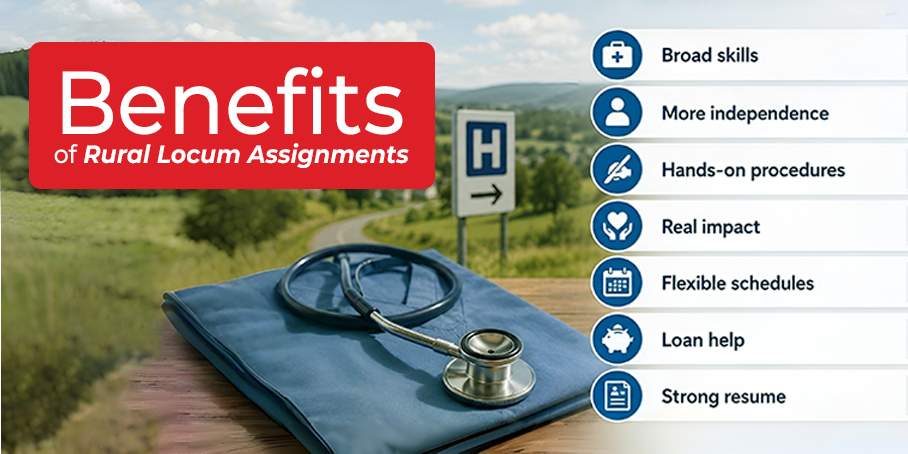
- Broad skills. You see more types of cases with fewer specialists to lean on.
- More independence. You build confidence fast when you must make the call yourself.
- Hands-on procedures. You often do work that would go to a specialist in a city.
- Real impact. One provider can change life for a whole small town.
- Flexible schedules. Many locums pick the length and timing that fit their life.
- Loan help. Some rural jobs qualify for state or federal loan repayment.
- Strong resume. Rural work stands out and can open doors later.
Challenges of Rural Locums (and How to Handle Them)
Rural work is rewarding. But it comes with real challenges.
Feeling alone. Fewer coworkers can feel lonely. Staying in touch with other providers online can help.
Few specialists nearby. Learn the local referral network early. Know which cases need a transfer.
Long drives. Plan routes ahead. Leave extra time for weather or road trouble.
Rough weather. Rural areas can have harsh winters. Keep basic supplies in your car.
Old systems. Some rural clinics use outdated EMR software. Ask for training before day one.
Housing questions. Confirm your housing before you arrive. Ask if it is furnished.
On-call load. Ask about call frequency up front so you know what to expect.
Recruiter Advice: Questions to Ask Before Accepting
Expert Tip: Before signing a contract, schedule a quick peer-to-peer call with the site medical director or a current locum on-site to verify daily expectations.
Key questions to ask your recruiter and the facility:
- What is the average daily patient volume and typical acuity level?
- What are the exact on-call expectations, response times, and call pay structures?
- What specialist support is available on-site versus via telemedicine?
- What facility is designated for high-level emergency transfers, and what is the transport protocol?
- Is housing provided directly, or is a stipend offered? Is the lodging close to the facility?
What Makes a Rural Locum Assignment Successful?
Doing well in a rural job takes more than clinical skill.
- Speak clearly with staff who may be used to a different provider.
- Stay open to new tools and workflows.
- Respect the pace and culture of the town.
- Learn how the clinic works before trying to change it.
- Work closely with nurses and staff. They know the patients well.
- Stay calm and flexible when plans shift at the last minute.
Future Outlook for Rural Locum Tenens
Rural shortages are likely to last for years. Many rural doctors are getting older. Some will soon retire. The AAMC says the U.S. could face a large doctor shortage over the next decade. Rural areas and primary care will likely feel it most.
A few trends may shape rural locum work ahead:
- More telehealth paired with in-person visits for specialist input
- More nurse practitioners and PAs taking on rural primary care
- Ongoing federal support, like loan repayment and rural training programs
- Care models that reward steady, connected care, even with rotating staff
These are trends, not certainties. Facilities will keep adjusting staff plans as needs change.
Conclusion
Rural communities depend on locum tenens providers to keep emergency rooms open, deliver primary care, and maintain surgical services. For clinicians, rural assignments offer strong earning potential, clinical autonomy, and the chance to make a clear impact where care is needed most.
If you are ready to explore high-impact rural opportunities, partnering with an experienced staffing team like Imperial Locum can help connect you with assignments tailored to your practice goals.
Disclaimer: This content is for informational purposes only and does not constitute formal legal, tax, or employment advice. Terms, benefits, and compensation vary by facility, state practice laws, and individual contract terms.
FAQs
Do rural locum tenens assignments usually include housing?
Yes. Most rural assignments provide furnished housing or a non-taxable housing stipend, alongside travel coverage (flights, rental car, or mileage reimbursement).
Can early-career physicians take rural locum assignments?
Yes, though comfort with clinical autonomy is essential. Early-career physicians should evaluate on-site support, back-up staffing, and transfer protocols before accepting solo-coverage roles.
How long do rural contracts typically last?
Assignments range from short weekend coverage blocks to 3–6 month contracts, with frequent opportunities for extension if both parties agree.