
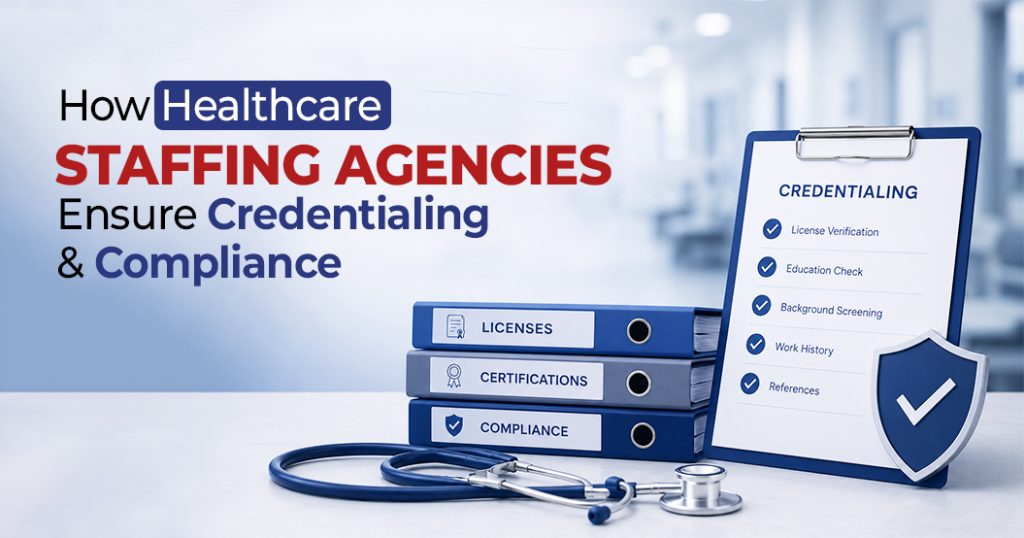
Healthcare professionals must complete extensive credentialing before starting any new assignment. This includes verifying state licenses, board certifications, DEA registration, malpractice coverage, work history, references, and background checks. A healthcare staffing agency manages this process to ensure that every requirement is met accurately and on time, helping to protect patients, clinicians, and healthcare facilities.
For traveling clinicians and locum providers, credentialing is even more complex because each new assignment often requires fresh verification and facility-specific documentation. This guide explains how a healthcare staffing agency manages credentialing and compliance, the challenges involved, and the best practices that keep clinicians assignment-ready while maintaining regulatory standards.
Understanding Healthcare Credentialing and Compliance
These four terms are commonly discussed together, but they refer to different parts of the healthcare credentialing and compliance process.
Credentialing is the process of confirming that a clinician’s education, training, licensure, and work history are accurate and up to date. It happens before an assignment and again on a set schedule afterward.
Compliance is the ongoing adherence to state, federal, and facility rules once credentialing is complete, including things like CME hours, DEA renewals, HIPAA training, and drug screening.
Privileging is granted by a specific hospital or facility. It authorizes a clinician to perform particular procedures within that institution, separate from the general license to practice.
Enrollment connects a clinician to a payer, such as Medicare or a commercial insurer, so services can be billed and reimbursed.
Why Credentialing Is Critical Before Every Assignment
Hospitals cannot legally place an unverified clinician on staff, and for good reason.
Patient safety comes first. A verified license and clean malpractice history confirm that a provider is fit to treat patients without added risk.
Regulatory compliance ties directly to Joint Commission and CMS Conditions of Participation. Facilities that fail to verify credentials risk citations, and in severe cases, loss of accreditation.
Facility accreditation depends on documented, repeatable credentialing processes. Surveyors expect a clear paper trail for every provider on staff, including temporary and traveling ones.
Risk management and legal protection go together. If a facility places an unverified provider and something goes wrong, both the facility and the staffing partner face liability exposure that thorough credentialing would have prevented.
Quality assurance rounds it out. Credentialing is not just a gate to pass through once, it is a quality signal that a facility’s entire provider network meets a consistent standard.
Step-by-Step Credentialing Process Used by Healthcare Staffing Agencies
Here is a realistic look at how a file moves from application to assignment.
Initial Application Review
A recruiter or credentialing coordinator reviews the clinician’s application for completeness — specialty, licensure state, availability, and any obvious gaps in history.
Document Collection
The clinician submits core documents: license, DEA criminal A registration, board certification, malpractice face sheet, CV, immunization records, and government-issued ID. Missing paperwork is the single biggest cause of early delays.
Primary Source Verification (PSV)
Every core credential gets confirmed directly with the issuing body — not with a copy the clinician provides, but with the state board, certifying board, or DEA registry itself.
License Verification
The staffing team confirms the license is active, unrestricted, and valid in the assignment state, checking for any pending disciplinary action.
Board Certification Verification
Specialty boards are contacted directly to confirm current, unexpired certification status.
DEA Verification
For prescribing roles, DEA registration is checked against the correct practice state and schedule authority.
Employment History
Recent work history is confirmed with previous employers to close any unexplained gaps.
Professional References
Peer references, typically two to three, speak to clinical competence and professional conduct.
Background Screening
A criminal background check is conducted at the federal, state, and county levels across every jurisdiction where the clinician has resided or worked in the past 7 years, along with nationwide sex offender registry checks.
NPDB Review
The National Practitioner Data Bank is queried for any history of malpractice payments, license actions, or clinical privilege restrictions.
OIG Exclusion Screening
The clinician is checked against the HHS Office of Inspector General exclusion list and the federal SAM.gov exclusion database to confirm eligibility to bill federal payers.
Facility Credentialing Package
Once internal verification is complete, the staffing team assembles a package matching that specific facility’s bylaws and submission requirements.
Hospital Privileging
The facility’s medical staff office reviews the package and grants privileges specific to the procedures and scope the assignment requires.
Assignment Approval
With privileging confirmed, the clinician is cleared for the start date, and onboarding logistics, badge access, EMR training, and orientation proceed.
Example: A nurse practitioner accepts a 13-week assignment across state lines. Before the start date, the staffing coordinator verifies the NP license in the new state, confirms DEA registration covers that state, checks references from the two most recent employers, and submits a facility-specific packet that includes immunization records and a competency checklist unique to that hospital’s emergency department.
Common Credentialing Challenges for Traveling Clinicians
Traveling clinicians often face additional credentialing hurdles because each state and healthcare facility may have its own licensing requirements, documentation standards, and verification processes.
- Multiple state licenses with different renewal cycles and continuing education rules.
- Expired certifications discovered late because the clinician assumed a home-state renewal covered every state.
- Delayed references when a former supervisor is slow to respond.
- Hospital-specific forms that duplicate information already on file elsewhere but must be resubmitted in a facility’s own format.
- Credential expiration mid-assignment, which can pause an active placement if not tracked proactively.
- DEA transfers that take longer than expected when a new state requires a separate registration rather than a simple address update.
- Privileging delays at facilities with infrequent credentialing committee meetings.
- Incomplete documentation, often immunization records or malpractice face sheets that were never centrally stored.
None of these are unusual. What separates a smooth placement from a stalled one is whether the staffing team catches these issues weeks in advance rather than days before a start date.
How Staffing Agencies Maintain Compliance for Regulated Roles
Healthcare staffing compliance depends on both the clinician’s responsibility to maintain active credentials and the agency’s role in verifying requirements before and during placements.
Typically handled by the agency:
- Coordinating state licensing applications and renewals
- Tracking DEA registration status
- Scheduling background checks and drug screening
- Managing facility-specific onboarding paperwork
- Monitoring credential expiration dates across every active clinician
Typically owned by the clinician:
- Completing required CME hours
- Maintaining current immunization records
- Passing HIPAA and OSHA training modules
- Participating in facility competency assessments
- Reporting any change in license status or new sanctions promptly
Clear division of these duties, spelled out before an assignment starts, prevents the most common source of last-minute compliance gaps.
Primary Source Verification (PSV): The Foundation of Credentialing
Primary Source Verification (PSV) means confirming a clinician’s credentials directly with the issuing organization instead of relying on copies or self-reported information. Licenses are verified with state boards, certifications with credentialing bodies, and education records with schools or training institutions.
Credentials such as medical licenses, DEA registration (when applicable), board certification, education, and training history often require PSV. The NCQA Credentialing Accreditation Standards recognize primary source verification as an essential part of maintaining accurate and compliant provider credentialing processes.
PSV helps healthcare organizations reduce risk by ensuring clinician information is accurate, current, and verified before an assignment begins.
Technology Is Transforming Healthcare Credentialing
Manual, paper-based credentialing used to mean weeks of phone calls and mailed verification letters. That has changed.
- Digital credential management platforms store all documents in a single searchable place.
- Automated reminders flag expiring licenses, certifications, and DEA registrations before they lapse.
- Secure document portals let clinicians upload files once and reuse them across assignments.
- Electronic verification connects directly to state license databases and certifying boards, cutting turnaround time significantly.
- CAQH profiles centralize provider data that multiple payers and facilities can pull from, reducing redundant paperwork.
- Credential tracking software gives coordinators a single dashboard view of every clinician’s status.
- AI-assisted document review flags missing fields or inconsistencies before a file reaches a human reviewer.
- Real-time compliance dashboards give facility administrators visibility into a clinician’s status without a phone call.
Questions Clinicians Should Ask Before Choosing a Staffing Agency
- Who manages my credentialing file from start to finish?
- How often are my credentials reviewed and monitored after I start an assignment?
- Does the team assist with new state license applications, or is that entirely on me?
- Who covers licensing and application fees?
- How are expiring credentials tracked, and will I get advance notice?
- What technology or portal will I use to submit and store documents?
- What support is available if a hospital’s privileging process stalls?
How a Healthcare Staffing Agency Supports Credentialing and Compliance
A well-run credentialing operation looks the same regardless of which agency runs it: dedicated coordinators assigned to each file, a verification process that follows current NCQA and Joint Commission expectations, clear communication with the clinician at every stage, and ongoing monitoring that continues well after an assignment starts.
The goal is not to move a file quickly at the expense of accuracy; it is to move it accurately, and let speed follow from good process rather than shortcuts.
Comparison Tables
Credentialing vs. Compliance
| Credentialing | Compliance |
| One-time and recurring verification of qualifications | Ongoing adherence to rules and requirements |
| Confirms who a clinician is on paper | Confirms a clinician keeps meeting standards day to day |
| Handled before an assignment begins | Continues throughout the assignment |
Credentialing vs. Privileging
| Credentialing | Privileging |
| Confirms general qualifications and licensure | Authorizes specific procedures at a specific facility |
| Performed by a staffing agency or CVO | Granted by a hospital’s medical staff office |
| Portable across assignments | Facility-specific and non-transferable |
Manual/Legacy Credentialing vs. Digital Credential Management.
| Manual/Legacy Credentialing | Digital Credential Management |
| Paper files, mailed verification letters | Centralized, searchable digital records |
| Expiration tracking done by memory or spreadsheet | Automated alerts before credentials lapse |
| Slower turnaround, higher error risk | Faster verification, fewer missed deadlines |
Credentialing Workflow
Application
↓
Document Collection
↓
Primary Source Verification
↓
Background Screening
↓
Compliance Review
↓
Hospital Privileging
↓
Assignment Confirmation
↓
Ongoing Monitoring
Conclusion
Credentialing and compliance are not a one-time checklist, they are a continuous responsibility that runs for as long as a clinician is active in the workforce. A thorough process protects patients, protects clinicians from placement into unqualified roles, and protects facilities from the regulatory and legal exposure that comes with an unverified provider.
A proactive approach on both sides, clinician and staffing partner, reduces delays, keeps documentation audit-ready, and makes each transition into a new assignment smoother than the last.
Before your next assignment, prepare your documents in advance, ask direct questions about how a staffing partner manages credentialing, and choose an organization that treats compliance as a core part of the job rather than an afterthought. Contact a credentialing team to discuss what a thorough, transparent process looks like for your next placement.
Frequently Asked Questions
What Is Healthcare Credentialing?
Healthcare credentialing is the process of verifying a clinician’s license, education, training, and work history before they are approved to practice at a healthcare facility.
What Is Primary Source Verification (PSV)?
Primary Source Verification (PSV) confirms a clinician’s credentials directly with the organization that issued them, such as a state licensing board or certification body, instead of relying on copies.
How Long Does Healthcare Credentialing Take?
Credentialing timelines vary by facility and specialty, but the process often takes several weeks. Delays usually depend on how quickly documents, references, and verification responses are completed.
Why Is Credentialing Important for Locum Tenens Clinicians?
Locum tenens clinicians often work across different states and facilities, each with unique requirements. Credentialing ensures their qualifications are verified before they begin a new assignment.