
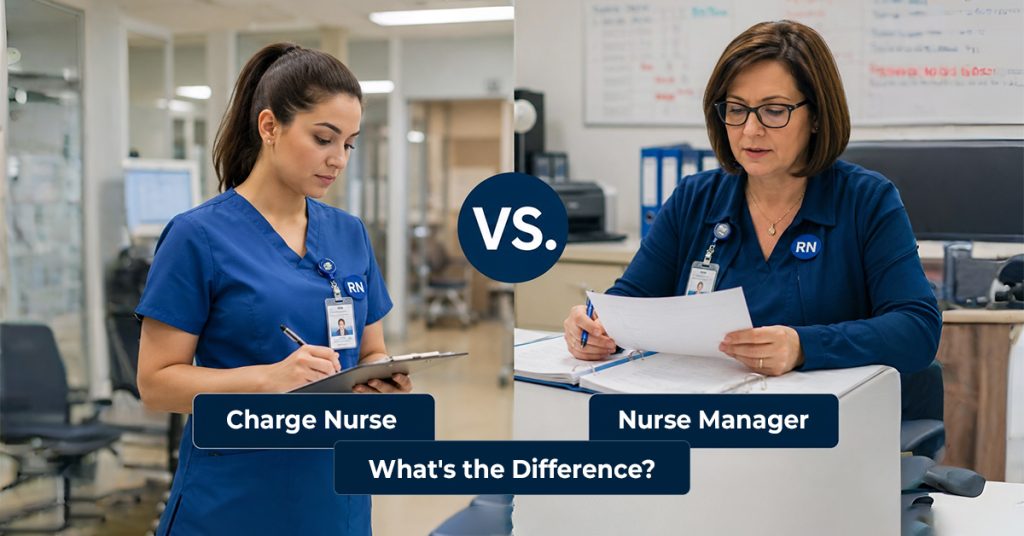
Charge nurses and nurse managers are both nursing leaders, but they serve different functions within a healthcare organization.
The charge nurse vs nurse manager distinction comes down to the scope of responsibility. A charge nurse leads patient care and staff during a shift, while a nurse manager oversees the daily operations, staffing, and performance of an entire nursing unit.
If you’re exploring Registered Nurse opportunities, understanding how these leadership roles differ can help you plan your next career move. Let’s compare the two roles, including responsibilities, salaries, and career progression.
What Is a Charge Nurse?
A charge nurse is a registered nurse who supervises patient care and coordinates nursing staff during a scheduled shift. Most charge nurses also provide direct patient care while leading the team during their shift.
Most employers require a charge nurse to hold an active Registered Nurse (RN) license. Many healthcare organizations prefer candidates with a Bachelor of Science in Nursing (BSN) and several years of bedside nursing experience. Leadership training or specialty certifications may also strengthen qualifications.
What Does a Charge Nurse Do?
As mentioned earlier, a charge nurse oversees daily clinical operations while supporting nurses, patients, and healthcare providers.
Common charge nurse responsibilities include:
- Assign patient workloads to nursing staff.
- Monitor patient care and clinical priorities.
- Support nurses with complex patient situations.
- Coordinate admissions, transfers, and discharges.
- Communicate with physicians and other healthcare professionals.
- Resolve workflow issues during the shift.
- Respond to emergencies and staffing changes.
- Ensure unit policies and safety standards are followed.
- Monitor and inventory medical supplies and equipment.
Quick insight: The charge nurse role requires strong clinical judgment, leadership, communication, and decision-making skills. This is because a charge nurse serves as the primary clinical leader for their shift.
What Is a Nurse Manager?
A nurse manager is a registered nurse who oversees the daily operations of a nursing unit or department.
Nurse managers typically hold an active Registered Nurse (RN) license and a Bachelor of Science in Nursing (BSN). Many employers also prefer a Master of Science in Nursing (MSN), Master of Healthcare Administration (MHA), or another leadership-focused graduate degree.
What Does a Nurse Manager Do?
A nurse manager leads the administrative and operational side of a nursing unit. They support nursing teams, monitor performance, and make decisions that improve patient care and workplace efficiency.
Common nurse manager duties include:
- Hire, train, and mentor nursing staff.
- Create staff schedules and manage staffing levels.
- Monitor budgets and department resources.
- Develop and enforce unit policies.
- Review quality and patient safety measures.
- Evaluate staff performance.
- Resolve workplace and patient care concerns.
- Work with hospital leadership to improve operations.
Unlike charge nurses, nurse managers spend less time providing direct patient care. Their primary focus is leading the unit. This involves supporting staff and meeting organizational goals.
Charge Nurse vs Nurse Manager – Full Comparison Table
A charge nurse leads patient care during a shift, while a nurse manager oversees the long-term operations of a nursing unit.
Here’s a detailed breakdown:
| Category | Charge Nurse | Nurse Manager |
| Primary focus | Direct patient care and shift coordination | Unit operations, staff management, and department performance |
| Leadership scope | Leads the nursing team during a shift | Leads an entire nursing unit or department |
| Daily duties | Assigns patients, supports staff, responds to clinical issues | Manages staffing, budgets, policies, quality, and performance |
| Patient care | Regularly provides direct patient care | Limited direct patient care |
| Decision-making | Shift-level clinical decisions | Department-level operational decisions |
| Reporting structure | Reports to the nurse manager or nursing supervisor | Reports to the director of nursing or senior nursing leadership |
| Staff supervision | Coordinates the on-duty nursing team | Hires, evaluates, mentors, and develops nursing staff |
| Education | RN license; BSN often preferred | RN license; BSN required by many employers, MSN or leadership degree often preferred |
| Experience | Several years of bedside nursing experience | Leadership experience, often including charge nurse experience |
| Salary | Generally lower than a nurse manager | Generally higher due to broader administrative responsibilities |
How Are Charge Nurses and Nurse Managers Similar?
Charge nurses and nurse managers share the same goal: delivering safe, high-quality patient care through effective nursing leadership. Here are some ways they’re similar:
Leadership and Management Skills
No matter which role you choose, you’ll be expected to lead others. Charge nurses guide the team during each shift, while nurse managers lead the unit over time. Both communicate clearly, solve problems, support staff, and make decisions that keep patient care on track.
Clinical Expertise and Knowledge
Strong clinical knowledge is essential in both roles. You need the experience to recognize patient needs, respond to changing conditions, and support evidence-based care. Your clinical background also helps you answer questions, guide less experienced nurses, and make confident decisions.
Advocacy for Patients and Staff
Both roles allow you to advocate for patients and your team. You help address patient concerns, promote safe care, and support a positive work environment.
What Sets a Charge Nurse Apart From a Nurse Manager?
The biggest difference between a charge nurse and a nurse manager is the scope of leadership. A charge nurse focuses on leading the team through the current shift. In comparison, a nurse manager focuses on the long-term success of the entire unit. Simply put, one role addresses immediate clinical priorities. The other shapes how the unit performs over time.
Then, there is patient involvement. A charge nurse stays involved in day-to-day clinical care, working closely with patients. Whereas a nurse manager spends more time improving processes and supporting the nursing team.
Another key difference is how success is measured. Charge nurses are often judged by how effectively they manage patient flow, respond to clinical issues, and keep the shift running smoothly. On the other hand, nurse managers are evaluated on larger outcomes. Their KPIs would include metrics such as staff retention, patient satisfaction, and departmental performance.
Salary Comparison: Charge Nurse vs Nurse Manager
Nurse managers typically earn more than charge nurses because they oversee staffing, budgets, and unit performance. Charge nurse salary is usually based on a registered nurse salary plus an hourly or shift differential for leadership responsibilities.
The table below compares typical salary expectations.
| Role | Typical Annual Salary | Notes |
| Charge Nurse | Around $93,600+ | The U.S. Bureau of Labor Statistics (BLS) does not report a separate salary for charge nurses. Most earn a registered nurse salary plus a leadership differential, often $1–$5 or more per hour, depending on the employer and location. |
| Nurse Manager | Around $100,000– $118,000+ | Nurse manager salaries vary by organization and experience. Recent industry data places the average near $101,000, while the BLS reports a median annual wage of $117,960 for medical and health services managers, a category that includes many nursing management positions. |
The following factors affect both charge nurse salary and nurse manager salary:
- Geographic location
- Years of nursing experience
- Education and certifications
- Healthcare setting
- Shift differentials and overtime
Quick insight: Nurse managers can earn specialty certifications through the American Organization for Nursing Leadership, including the Certified in Executive Nursing Practice (CENP®) and the Certified Nurse Manager and Leader (CNML®). Additional nursing certificates proving specific expertise can lead to higher compensation.
Which Role Is Right for You?
There is no one-size-fits-all answer. The right role depends on your career goals, interests, and level of experience. For instance, choose a charge nurse role if you:
- Enjoy direct patient care.
- Want to lead during your shift.
- Like solving clinical challenges in real time.
- Are exploring your first leadership position.
In comparison, a nurse manager role would be a better fit if you:
- Enjoy mentoring and developing nursing staff.
- Want to improve unit performance.
- Prefer planning, organizing, and managing operations.
- Are ready for broader leadership responsibilities.
Your career goals may also change over time. A role that fits you today may not be the one you want five years from now. We recommend exploring temporary assignments to gain experience and make informed decisions.
Can a Charge Nurse Become a Nurse Manager?
Yes. Many nurse managers begin their careers as charge nurses. The charge nurse role builds leadership, communication, and decision-making skills that prepare you for broader management responsibilities.
If your goal is to lead an entire nursing unit, working as a charge nurse is a common and valuable next step.
How to Transition from Charge Nurse to Nurse Manager
Moving from a charge nurse to a nurse manager requires leadership experience, education, and management skills. Here’s what you can do:
- Build leadership experience. Volunteer to mentor new nurses, lead projects, and coordinate unit activities.
- Earn the required education. Most employers prefer a Bachelor of Science in Nursing (BSN). Some nurse manager positions also require or prefer a Master of Science in Nursing (MSN) or Master of Healthcare Administration (MHA).
- Develop management skills. Learn about staffing, budgeting, quality improvement, and conflict resolution.
- Pursue leadership certifications. Certifications in nursing leadership can strengthen your qualifications and demonstrate your commitment to professional growth.
- Apply for leadership opportunities. Assistant nurse manager, clinical coordinator, or nurse supervisor roles can help you gain additional management experience before becoming a nurse manager.
Take the Next Step in Your Nursing Career
Whether you choose the charge nurse role or a nurse manager position, each step builds your leadership experience and opens new career opportunities. The right path depends on where you want to make the greatest impact.
If you’re ready to explore your next opportunity, Imperial Locum connects healthcare professionals with roles that match their experience, skills, and career goals. Browse our latest nursing positions to find the right fit for your next career move.
Frequently Asked Questions
Which role has more leadership responsibility?
A nurse manager has broader leadership responsibility. Charge nurses lead the nursing team during a shift, while nurse managers oversee staffing, budgets, quality improvement, and the overall performance of a nursing unit.
Do charge nurses and nurse managers work the same schedule?
No. Charge nurses usually work clinical shifts, which may include nights, weekends, and holidays. Nurse managers often work regular business hours but may be available outside scheduled hours to address operational issues.
What skills make a successful charge nurse or nurse manager?
Strong communication, leadership, critical thinking, and decision-making skills are essential for both roles. Nurse managers also need experience with staffing, budgeting, quality improvement, and team development.
Can a new registered nurse become a charge nurse?
Most employers require several years of bedside nursing experience before assigning charge nurse responsibilities. The exact requirement varies by specialty and healthcare organization, but clinical experience and leadership ability are essential.
Do nurse managers still provide direct patient care?
Nurse managers primarily focus on administrative and leadership responsibilities. Some may assist with patient care during emergencies or staffing shortages, but their day-to-day work centers on managing the unit rather than carrying out a regular patient assignment.