Becoming a Clinical Laboratory Scientist (CLS) in California requires the right education, clinical training or qualifying work experience, and state licensure. You must meet the requirements set by the California Department of Public Health (CDPH), Laboratory Field Services (LFS), before working in a position that requires a CLS license.
The application process depends on your academic background and laboratory experience. You may need specific science courses, an approved clinical training program, and an accepted certification examination. Understanding these requirements can help you prepare your documents and avoid delays.
This guide explains how to get a clinical laboratory scientist license in California, qualify for a CLS trainee license, understand the difference between CLS and MLT roles, and explore salary information and career opportunities.
What Does a Clinical Laboratory Scientist Do?
A Clinical Laboratory Scientist analyzes patient specimens to help healthcare professionals diagnose, monitor, and treat medical conditions. These professionals work with blood, body fluids, and other samples in clinical laboratories.
Common responsibilities include:
- Performing tests in clinical chemistry, hematology, microbiology, and blood banking.
- Operating laboratory instruments and reviewing test results.
- Following quality control procedures and laboratory safety standards.
- Identifying unusual results and reporting critical findings according to laboratory protocols.
- Maintaining accurate records of laboratory testing.
California’s generalist CLS license permits qualified professionals to work across all specialty areas of the clinical laboratory. This broad scope can support career opportunities in hospital laboratories, diagnostic facilities, and other eligible clinical testing settings.
California Clinical Laboratory Scientist License Requirements
The CDPH Laboratory Field Services program oversees clinical laboratory personnel licensing in California. Before applying, check the academic, training, experience, and examination requirements for the generalist CLS license.
Education and Required Coursework
You generally need a bachelor’s degree and specific science coursework to qualify for a California CLS license. Your transcripts must show that you completed the required subjects and credit hours.
Under the California requirements effective January 1, 2025, the generalist CLS academic requirements include:
- Chemistry: At least 16 semester or equivalent quarter credit hours, including quantitative analysis or analytical chemistry and clinical chemistry or biochemistry.
- Biological science: At least 16 semester or equivalent quarter credit hours, including medical, clinical, or pathogenic microbiology, hematology, and immunology.
- Additional science coursework: At least 3 semester or equivalent quarter credit hours in physics, mathematics, or statistics.
These requirements may affect applicants whose degrees or coursework follow older academic standards. Review your transcript carefully and contact LFS if a course title does not clearly show the required subject matter. The department may request a course description or syllabus for clarification.
Clinical Training or Qualifying Work Experience
Applicants must also meet California’s clinical training or work experience requirements. One common route requires at least one year of post-baccalaureate clinical training as a CLS through an approved training program.
Another route may qualify applicants who have at least one year of relevant work experience performing high-complexity testing in hematology, chemistry, blood banking, and microbiology. The training or experience must cover the required areas of the clinical laboratory.
Not all laboratory experience qualifies. California does not accept experience gained as unlicensed laboratory staff in the state toward clinical laboratory licensure. Work in research, academic, veterinary, forensic, or pharmaceutical laboratories also does not automatically meet the clinical training requirements.
Certification Examination and California Quiz
You must meet the examination requirements for your license category. California recognizes examinations from approved certification organizations, so check the current LFS list before registering.
The state also requires applicants for the generalist CLS license to complete the online California quiz on state laboratory laws and regulations during the application process. Passing a certification examination alone does not guarantee licensure. You must also satisfy the education, training or experience, documentation, and application requirements.
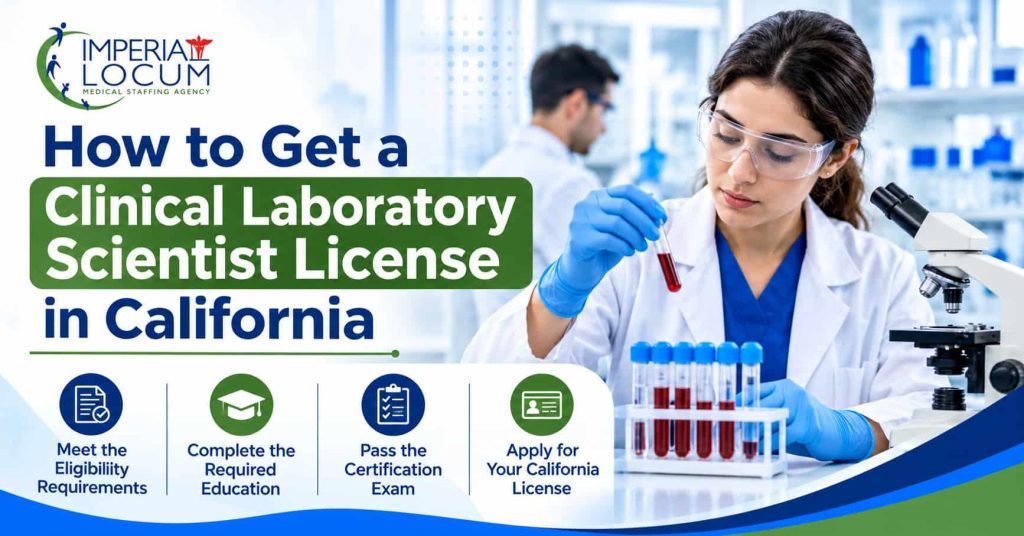
How to Apply for a Clinical Laboratory Scientist License in California
Once you confirm that you meet the eligibility requirements, prepare your documents and apply through the state’s licensing system.
Step 1: Review Your Education and Transcripts
Check your bachelor’s degree and science coursework against the current California requirements. Request official transcripts from your college or university.
LFS requires the issuing institution to send official transcripts directly to the department. Applicant-uploaded scans or photocopies do not meet this requirement. If you completed your education outside the United States, review the department’s instructions for foreign education and course-by-course credential evaluations.
Step 2: Complete an Approved Training Program if Needed
If you do not have the required clinical training or qualifying work experience, look for a CLS training program approved by California LFS. Confirm its admission requirements and the training areas it covers.
You may need a CLS trainee license before entering the program. Check the trainee license requirements separately, because eligibility for supervised training does not mean you already qualify for a full CLS license.
Step 3: Create an Online Licensing Account
Visit the official California clinical laboratory personnel licensing page and follow the instructions to create a Personnel Electronic Renewal Licensing (PERL) account.
After signing in, select the appropriate application, complete the required fields, and submit the supporting information. The exact documents depend on your education and eligibility route.
Step 4: Submit Supporting Documents and Complete the Requirements
Your application may require:
- Official transcripts showing your degree and coursework.
- Verification of qualifying clinical training or work experience.
- Proof of an accepted certification examination.
- Completion of the California quiz on laboratory laws and regulations.
- A course-by-course credential evaluation, if applicable to your education.
Follow the current instructions for your license category. Pay the application fee and check your account for updates or requests for additional documents. Incomplete applications may be abandoned, so respond to requests from LFS promptly.
What Is a CLS Trainee License?
A CLS trainee license allows eligible applicants to train in a department-approved Clinical Laboratory Scientist training program. It helps qualified candidates complete the clinical training needed for a full license.
Applicants must meet the trainee license’s academic requirements and submit the requested documentation. The coursework requirements are similar to those for the generalist CLS license, including the updated requirements that took effect on January 1, 2025.
A trainee license has a limited purpose. It permits training in the specialty areas covered by an approved CLS program, but it does not authorize you to work as a fully licensed Clinical Laboratory Scientist.
If you need additional training, review the official CLS trainee license requirements before applying. You should also confirm that your intended training program has CDPH approval.
CLS vs. MLT: What Is the Difference?
Clinical Laboratory Scientists and Medical Laboratory Technicians both perform laboratory testing, but their education requirements and authorized duties differ. California issues separate licenses for these roles.
| Comparison | Clinical Laboratory Scientist (CLS) | Medical Laboratory Technician (MLT) |
| Typical education | Bachelor’s degree with required coursework | Associate degree or qualifying coursework |
| California license | Generalist CLS license | MLT license |
| Work responsibilities | Performs testing across the clinical laboratory specialties permitted by the license | Performs testing within the limits of the MLT license |
| High-complexity testing | May perform high-complexity testing within the authorized scope | California MLTs cannot perform tests classified as high complexity under CLIA |
California MLTs have specific limits on the moderate-complexity tests they may perform as well. Review the official California MLT license requirements for details.
If you want to move from an MLT role to a CLS career, review the CLS academic, training, and examination requirements. An MLT license does not automatically qualify you for a CLS position.
Clinical Laboratory Scientist Salary in California
A clinical laboratory scientist salary depends on experience, employer, location, shift, and the type of laboratory work involved. Hospital laboratories, diagnostic facilities, and temporary assignments may offer different compensation packages.
The U.S. Bureau of Labor Statistics reported a national median annual wage of $62,930 in May 2025 for clinical laboratory technologists and technicians. This category includes both technologists and technicians, so the figure does not represent the California CLS salary specifically.
For California-specific wage estimates, consult the BLS occupational employment and wage data for California. These estimates cover a broader occupational category rather than CLS license holders alone.
When comparing job offers, consider the hourly rate, expected schedule, benefits, location, and required qualifications. For temporary assignments, review the contract terms to understand the compensation and work expectations before accepting a position.
If you are considering other laboratory career options, read about clinical lab assistant roles to understand the responsibilities of this related position.
Start Your Clinical Laboratory Scientist Career in California
Once you meet California’s licensing requirements, you can look for positions that match your credentials and experience. Review each employer’s requirements carefully, especially if the position involves specialized testing or a correctional healthcare setting.
Imperial Locum lists a Clinical Laboratory Scientist position at Vacaville Correctional Facility, California. Review the job details to determine if the opportunity matches your qualifications and career goals.
Frequently Asked Questions
How Long Does It Take to Get a Clinical Laboratory Scientist License in California?
Processing usually takes 8–12 weeks after the board receives a complete application. Allow extra time for credential verification and document submission.
When Should I Apply for a California CLS License Before a Travel Assignment?
Apply at least 12 weeks before your assignment starts. Applying as soon as you accept the role gives you more time to complete the process.
How Much Does a California Clinical Laboratory Scientist License Cost?
The CLS endorsement application and renewal fees are $300 each. Cytotechnologist/CLM fees are $260. Check the California Department of Public Health website for current fees.
Does California Issue Temporary Clinical Laboratory Scientist Licenses?
No, California does not issue temporary CLS licenses. You must receive your permanent license before starting work, so apply well in advance.
What Are the Renewal Requirements for a California CLS License?
California CLS licenses require 12 hours of continuing education each year. Check the state’s current rules before renewing your license.
How Can I Apply for a California CLS License by Endorsement?
Submit an endorsement application through the state portal and arrange verification of your current license. You may also need to meet additional California requirements. Confirm the latest steps with the California Department of Public Health.
What Should Travel Medical Laboratory Professionals Know Before Working in California?
Apply for your California license as soon as you accept an assignment. Request credential verification early and keep your active credentials ready for facility onboarding.