
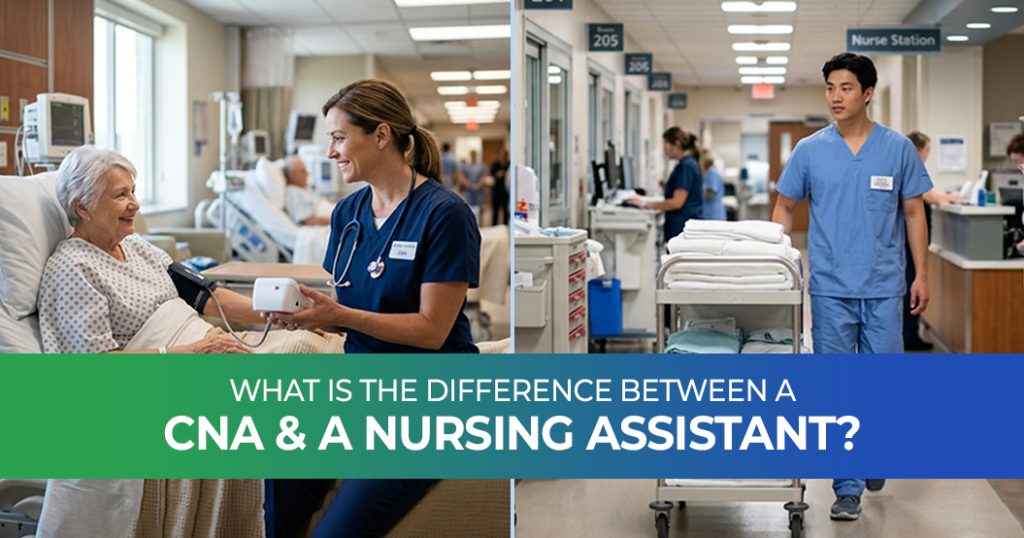
Healthcare facilities need reliable support staff to deliver safe patient care. Many employers also work with a healthcare staffing agency to find qualified professionals quickly. Among the most common support roles are nursing assistants and certified nursing assistants, often called CNAs.
Many people think these jobs are the same. However, there are important differences.
A CNA is a nursing assistant who has completed formal training and earned certification. A nursing assistant may help patients in similar ways but may not hold a state certification.
Understanding these differences helps job seekers and employers make better decisions.
Quick Answer
The main difference is certification.
A nursing assistant helps patients with daily care needs.
A CNA does the same work. However, a CNA also completes approved training and passes a state exam.
As a result, CNAs often qualify for more jobs and more duties.
What Is a Nursing Assistant?
A nursing assistant helps patients with basic care.
These workers support nurses and other healthcare professionals. They spend a lot of time helping patients stay safe and comfortable.
Their work often includes daily care tasks.
Common duties include:
- Helping patients get dressed
- Assisting with bathing
- Helping with grooming
- Making beds
- Serving meals
- Helping patients eat
- Assisting with walking
- Reporting concerns to nurses
Nursing assistants play an important role in patient care.
Without them, many healthcare facilities could not operate smoothly.
What Is a CNA?
A CNA is a Certified Nursing Assistant.
The role includes many of the same duties as a nursing assistant. However, a CNA must complete special training and pass a certification exam.
After passing the exam, the CNA joins the state’s nurse aide registry.
Because of this training, CNAs often take on more patient care tasks.
Common CNA duties include:
- Checking blood pressure
- Taking temperatures
- Recording pulse rates
- Monitoring patients
- Reporting changes in health
- Assisting with daily care
State rules may vary. Therefore, CNA duties can differ from one state to another.
CNA vs Nursing Assistant: Key Differences
While both roles support patient care, there are several important differences. Understanding these distinctions can help job seekers choose the right career path and help employers make informed hiring decisions.
Certification
Certification is the biggest difference.
A nursing assistant may receive training on the job.
A CNA must complete formal education and testing.
Therefore, employers often view CNA credentials as proof of skills and knowledge.
Training
Training requirements also differ.
Many nursing assistants learn through workplace instruction.
However, CNAs complete state-approved programs.
These programs usually include:
- Classroom learning
- Skills training
- Clinical practice
As a result, CNAs receive more structured preparation.
Job Responsibilities
Both roles support patients.
However, CNAs may perform additional tasks.
For example, many CNAs:
- Take vital signs
- Record patient information
- Observe patient conditions
- Report health changes
These duties help nurses provide better care.
Employment Opportunities
CNAs often have access to more jobs.
In addition, many hospitals require CNA certification.
Long-term care facilities also prefer certified candidates.
Therefore, certification can improve job prospects.
Salary Potential
Pay varies by location and employer.
However, certified workers often earn more.
This happens because certification shows a higher level of training.
As a result, many employers offer better pay to CNAs.
Those who want a deeper look at earnings, job outlook, and pay factors can also explore How Much Do Certified Nursing Assistants Make?
Similarities Between CNAs and Nursing Assistants
Despite their differences, both roles share many daily responsibilities. In fact, both professionals play an important role in supporting patients and healthcare teams.
Both professionals:
- Help patients with daily activities
- Support nurses
- Promote patient safety
- Provide comfort
- Assist with mobility
- Build patient trust
Both positions also require compassion and patience.
Most importantly, both help improve patient experiences.
Where Do CNAs and Nursing Assistants Work?
These professionals work in many healthcare settings.
Common workplaces include:
- Hospitals
- Nursing homes
- Assisted living communities
- Rehabilitation centers
- Home healthcare agencies
- Long-term care facilities
Each setting offers different experiences.
However, patient care remains the main focus.
Why Certification Matters
Certification benefits both workers and employers.
First, certification confirms skills.
Next, it shows commitment to the profession.
Also, it helps employers identify qualified candidates.
As a result, certified workers often stand out during hiring.
Many healthcare facilities prefer certified staff because they help support quality care standards.
How to Become a CNA
Becoming a CNA is one of the fastest ways to start a healthcare career. While requirements vary by state, most candidates follow the same basic process to earn certification and begin working in patient care.
The journey typically includes meeting eligibility requirements, completing approved training, passing a certification exam, and joining the state’s nurse aide registry.
Step 1: Meet Basic Requirements
Most programs require a high school diploma or equivalent. Some states may have additional requirements.
Step 2: Complete Training
Next, enroll in a state-approved CNA program. Training usually combines classroom lessons and hands-on practice.
Students learn:
- Infection control
- Patient safety
- Basic nursing skills
- Communication techniques
- Personal care support
Step 3: Pass the Exam
After training, take the state certification exam.
The exam usually includes:
- Written questions
- Skills testing
Passing both sections is important.
Step 4: Join the State Registry
After passing, the state adds the candidate to the nurse aide registry. Then, the individual can apply for CNA positions.
Skills Needed for Success
In addition to clinical knowledge, both roles require strong people skills.
Successful nursing assistants and CNAs often have:
- Good communication skills
- Attention to detail
- Physical stamina
- Compassion
- Patience
- Reliability
These qualities help workers provide better patient care.
Career Growth Opportunities
Many healthcare professionals start as CNAs.
The role can create a strong foundation for future careers.
Some CNAs later become:
- Licensed Practical Nurses (LPNs)
- Registered Nurses (RNs)
- Healthcare managers
- Clinical specialists
According to a review published in the Journal of Gerontological Nursing, researchers identified several structured career transition programs designed specifically to help nursing assistants advance into nursing careers.
These programs help address workforce shortages while creating new opportunities for frontline healthcare workers.
The findings highlight the growing recognition of CNAs as an important talent pipeline for the nursing workforce.
Which Role Is Better?
Neither role is better for everyone.
The right choice depends on career goals.
A nursing assistant position may offer a quick entry into healthcare.
However, CNA certification often provides more opportunities.
Many people choose certification because it can lead to:
- More job options
- Higher earning potential
- Greater responsibilities
- Stronger career growth
As a result, CNA certification remains a popular choice.
Final Thoughts
For healthcare employers and job seekers, understanding this distinction can make hiring and career decisions much easier.
Whether someone chooses a nursing assistant role or pursues CNA certification, both positions offer valuable opportunities to make a meaningful impact on patient care.
Frequently Asked Questions
Can a nursing assistant become a CNA without healthcare experience?
Yes. Most CNA programs accept beginners with no prior healthcare experience. After completing training and passing the state exam, candidates can become certified.
Do hospitals hire nursing assistants who are not certified?
Some hospitals do hire nursing assistants without certification. However, many healthcare facilities prefer or require CNA credentials because they demonstrate verified skills and training.
How long does it take to become a CNA?
Most CNA programs take between four and twelve weeks to complete. Program length depends on state requirements, training schedules, and the education provider.
Is CNA experience useful before nursing school?
Yes. Many nursing students work as CNAs before entering nursing programs. The role helps develop patient care skills, communication abilities, and familiarity with healthcare environments.
Can CNAs work in home healthcare settings?
Yes. Many CNAs work in home healthcare. They assist patients with personal care, mobility support, meal preparation, and daily living activities while helping clients remain independent at home.